Update trigger - #4
Open
tylerc-govsignals wants to merge 1794 commits into
Open
tylerc-govsignals wants to merge 1794 commits into
tylerc-govsignals wants to merge 1794 commits into
Conversation


…ids (#4770)

Skew protection resolves a run's worker by (environmentId, externalId,
status=DEPLOYED). A miss parks the run and then expires it, so
deployments
predating the feature — which already carry the same value in commitSHA
— need
externalId populated to stay reachable. Vercel instant-rollback is the
sharpest
case, which is why the scope is the current promotion plus a recent
window
rather than current alone.

Follows the existing backfill shape: admin PAT, keyset cursor over
environments,
per-environment action results, pMap, dryRun defaulting to true. Reuses
normalizeExternalDeploymentId so a backfilled id is byte-identical to
what a
build writes, and the update re-checks externalId IS NULL so a deploy
landing
mid-backfill keeps its own id.

Refs TRI-13464.

…d shared test utilities (#4772)

## Summary

Adds the read comparator for the in-progress migration of the run
execution-snapshot log from Postgres to Redis. The comparator samples a
single read against both stores, normalizes the two results to one
shape, and reports any per-field difference with a tagged metric. It
never serves a read itself: the diff layer imports only types, so it
cannot hold a store client, and a test enforces that by failing if any
value import appears.

Also adds a combined Postgres-and-Redis test fixture and two shared test
utilities (a cluster-slot assertion and a generic fault-injection
harness) that the parallel Redis-store work reuses.

Everything here is inert. Nothing constructs the comparator, so merging
changes no runtime behavior. It becomes active only when a later change
turns on compare mode.

## Notes

The divergence classes separate real differences (scalar, ordering,
waitpoint id set, validity, missing on one side) from two expected
classes that must not be driven to zero: a rotated idempotency key, and
a Redis-only surplus at a since-cursor tie. The since comparison is
direction sensitive: a Postgres-only entry at the cursor is always a
lost write, never an expected tie.

Adds an `ADMIN_DASHBOARD_ENABLED` env var (default: enabled) that turns
the admin dashboard and user impersonation off for an entire instance.

When disabled:
- every admin dashboard page redirects away, and the admin navigation
isn't rendered
- existing impersonation cookies are ignored, and any lingering session
is actively terminated with an audit record
- every flow that could start an impersonation responds 404, and no
impersonation tokens are minted

Stopping an impersonation always works regardless of the flag, so
nothing gets stuck. Machine-to-machine admin API endpoints are not
affected. The variable is documented for self-hosters; instances that
don't set it are unaffected.

…when a runs list query is too expensive (#4773)

## Summary

When a runs list query is too expensive to complete, it now fails with a
clear, actionable error instead of a generic 500.

Previously, a runs list query that exceeded ClickHouse resource limits
threw an opaque error. On the public `runs.list` API that surfaced as a
retryable 500, so a customer task calling it would keep retrying a query
that could never succeed. On the dashboard it rendered as a generic
error page with no hint about what to do.

## Fix

The ClickHouse client now tags resource-limit failures (memory, time,
rows, bytes) with their error type, and the runs repository maps those
to a dedicated `RunsListQueryError` (HTTP 422).

- `runs.list` API returns 422 with a message telling the user to narrow
their `created_at` range, plus an `x-should-retry: false` header so the
SDK does not retry it.
- The dashboard runs list (and the errors, scheduled, standard-task,
agents, and webhooks list views) render a shared error state with the
same guidance, so a too-broad time filter is recoverable by the user.
Switching between deployments in the dashboard re-fetched the whole
build log stream from record zero and re-rendered the list line by line
every time. Logs are now cached per deployment for the lifetime of the
tab: revisiting a deployment shows its logs immediately, and the stream
is resumed from the next unread record rather than restarted. Finished
deployments whose stream has been read through the `finalized` event are
served entirely from the cache.

### Changes

The stream/cache logic moved out of the route into a `useDeploymentLogs`
hook. On each deployment switch it seeds state from the cache, resumes
the S2 read session at `nextSeqNum`, and writes back on cleanup or
natural session end. Completion is derived from the stream's own
`finalized` event (plus a terminal deployment status), not from the
session closing, so a session cut short by token expiry or a proxy
cannot pin a truncated log in the cache.

Memory is bounded by a small LRU (`deploymentLogsCache`): at most 20
deployments and 20,000 log lines in total, least recently viewed evicted
first. The most recently viewed deployment is always kept, so a single
very large log can temporarily exceed the line budget on its own.
Records are batched into one state update per tick instead of one per
line.
## What

Makes `RoutingRunStore` correct when the run-ops layer routes across
more than two Postgres stores. Today it routes between a gen-1 `new`
dedicated database and a `legacy` control-plane database; this
generalizes every routing policy to N shards while keeping the two-store
behaviour byte-identical.

The change sets the four routing decisions that were implicit in code
order, and fixes one hazard that failed silently:

- **Id → shard key.** The router resolves a shard key with
`resolveShard` instead of the binary residency classifier, so a gen-2 id
reaches its own shard through the keyed map.
- **Membership vs routing.** `#distinctStores` (one entry per physical
database, aliases excluded by a declared `aliasOf`) drives every sum,
probe, and merge; `#shards` drives routing. An aliased shard can no
longer make a sum count one database twice.
- **Probe order.** A keyless lookup stays a sequential short-circuit at
two stores; above two it fans out in parallel, picks by precedence,
tolerates a single down leg, and keeps the canonical not-found throw on
the legacy leg.
- **Precedence and duplicates.** One merge helper across all four merge
sites. A duplicate id confined to `{new, legacy}` stays silent (the
known drain-mirror case); any other cross-shard duplicate increments
`runops_shard_duplicate_id_total` and logs at error level.
- **Disjoint sum (the silent hazard).** `countPendingWaitpoints` and the
waitpoint collector now partition absent ids by shard and **union by
id** rather than summing counts. A drain-mirrored waitpoint on both
gen-1 stores is counted once, so a blocked run can no longer hang
forever on a double-counted pending waitpoint.
- **Waitpoint completion.** A gen-2 waitpoint completes on its own
shard, overriding the legacy pins; a cuid waitpoint keeps its two-member
gen-1-pair probe unchanged.
- **Fail-loud creates.** A create with no shard key throws instead of
silently defaulting to `new`. An id resolving to an unconfigured shard
throws instead of being dropped.

Two new counters are exported: `runops_shard_duplicate_id_total` and
`runops_waitpoint_probe_fallback_total`.

## Why it is safe to merge

With only `{new, legacy}` configured every generalized rule reduces to
today's behaviour. `resolveShard` returns exactly what the old
classifier returned for every id shape that exists today, and no gen-2
id is minted yet. The only intentional behaviour change is the fail-loud
create throw; an enumeration of production call sites confirmed no
caller trips it.

## Testing

- New container-free algebra suite (50 cases) over probe order,
precedence, the duplicate alarm, the disjoint-sum partition, the
waitpoint probes, and the fail-loud paths.
- New `runOpsStore.nShardMatrix.test.ts` runs a four-store matrix
(legacy + new + two gen-2 shards) against real Postgres containers: the
disjoint-sum union, the alias topology, cross-tree completion,
pagination merges, and mixed-id hydration.
- New `makeNShardRunOpsPostgresTest(k)` fixture in
`@internal/testcontainers`.
- Full run-store corpus green: 71 files, 480 tests. Typecheck, lint,
format, and knip all clean.

## Notes

- Draft: opened for review; not marking ready yet.
- No changeset or `.server-changes` file: internal routing
infrastructure, no user-visible behaviour change.
- TRI-13427.
Auto-scroll now only follows while you are at the bottom. Scrolling up
pauses it; scrolling back to the bottom, or clicking the new
scroll-to-bottom button in the log header, resumes it. When you are at
the bottom the same button scrolls to the top. Switching to another
deployment starts at the bottom again.

…4777)

The environment variable key and value inputs did not set an
autocomplete attribute, so browsers could offer to autofill or save
typed values as saved credentials. This sets `autoComplete="off"` on
those inputs in both the create and edit forms, matching the
`autoComplete="off"` convention already used on the other
credential-name inputs.

`autoComplete="off"` is a best-effort hint. Browsers may still ignore it
for password-typed fields, so this is defense-in-depth hardening, not a
hard guarantee that a password manager cannot store the value.

…4764)

Part of the RunOps N-way sharding work.

This lets the webapp hold N run-ops stores, configured by a single
`RUN_OPS_SHARDS` JSON descriptor, and routes to them through the
existing keyed router. **Inert with `RUN_OPS_SHARDS` unset** — the
topology, the wiring and `ROUTING_ENABLED` are byte-identical to today.

## What's here

- **`RUN_OPS_SHARDS`** — a zod-validated JSON array of shard descriptors
(`key`, `region`, `url`, `replicaUrl`, `directUrl`, `replication`,
`knobs`, `aliasOf`), validated at boot in the `parseMachinePresetCsv`
style. Unset or `[]` → no shards.
- **One run-ops client factory** —
`buildRunOpsWriterClient`/`buildRunOpsReplicaClient` collapse into one
`buildRunOpsClient` parameterized by role and resolved pool knobs. The
control-plane builders (`buildWriterClient`/`buildReplicaClient`) are a
separate path and stay untouched; every resolved value matches the
former builders.
- **Shard loop in `selectRunOpsTopology`** — one client pair per
descriptor; an `aliasOf: "new"` descriptor reuses the new store's
clients by reference and opens no pool.
- **N-way `buildRunStore`** — builds N dedicated stores + the keyed
router via a new `RoutingRunStore.fromShards`, keeping the two-store
compat router when no shards are configured.
- **`UnknownShardKey`** — raised when an id resolves to an unconfigured
key; never falls back to another store. `fromShards` injects
`resolveShard` so a gen-2 id routes to its own shard.
- **Per-shard transaction resilience** — each shard gets its own retry
budget.
- **Mint bound** — `computeMintShard` intersects the active mint list
with the configured descriptor keys, so a key with no descriptor is
never minted into.
- **Boot table** — logs `key`, address fingerprint (host:port/db, no
credentials), and role, only when shards are configured.

## Ordering constraint

Do **not** configure a `RUN_OPS_SHARDS` descriptor in any environment
until the routing-semantics change (TRI-13427) lands — three fan-out
sites still truncate at N>2. Merging this PR alone is safe (inert with
the var unset); configuring a descriptor is what must wait.

## Testing

- Run-store corpus: green with zero test-file diffs (the bit-identical
proof for the compat router).
- `runOpsDbTopology.test.ts` 17/17, `runStore.server.test.ts` 4/4,
`runOpsMigration` family 149/149.
- New unit suites: descriptor validation, pool-knob value tables,
`fromShards` routing + `UnknownShardKey`, boot-table formatter, mint
bound.
- typecheck (webapp + run-store), knip, lint, format: pass.

## Changelog

Internal run-ops sharding infrastructure. No changeset or
`.server-changes`: the change is inert with `RUN_OPS_SHARDS` unset and
has no user-visible behaviour.

🤖 Generated with [Claude Code](https://claude.com/claude-code)

---------

Co-authored-by: Claude Opus 4.8 <noreply@anthropic.com>
Deployments currently leave little analytical trace. This PR makes every
deployment emit two analytics events to enable useful queries. It also
enables comparing deployments across build paths, CLI versions,
runtimes, and orgs.

### Where the events come from

```
 trigger deploy
      │
      ▼
  initialize ─────────────────────────────▶ ✨ deployment.initialized
      │ createdAt
      ▼
   PENDING      waiting for a build slot        ┐
      │ startedAt                               │ queue time
      ▼                                         ┘
  INSTALLING    build server installs deps      ┐
      │ installedAt      (native paths only)    │ install time
      ▼                                         ┘
   BUILDING     the image is built              ┐
      │ builtAt                                 │ building time
      ▼                                         ┘
  DEPLOYING     indexing + registry push        ┐
      │ deployedAt / failedAt / canceledAt      │ deploying time
      ▼                                         ┘
  DEPLOYED · FAILED · TIMED_OUT · CANCELED
      │
      └───────────────────────────────────▶ ✨ deployment.finished
```

`deployment.finished` fires exactly once, whichever way the deployment
ends, and is backdated to cover the deployment's real lifetime. Not
every path visits every state (Depot deploys skip PENDING/INSTALLING,
for example) — a phase duration is simply omitted when its state was
never entered.

### What each event carries

- **Which path built it**: `depot`, `native`, or `native_local_bundle`
- **How it ended**: status, plus an error class and message when it
failed
- **How long each phase took**: queue, install, building, deploying, and
total — derived from the timestamps above
- **Who and with what**: org, project, environment, runtime, CLI
version, and how the deploy was triggered (CLI, GitHub, Vercel)

With that, one query gives failure rate per build path, duration
percentiles per phase, adoption per CLI version, or a per-org health
table.

### Fixes that ride along

- The old `deployment.outcome` span was silently dropped ~95% of the
time (it was subject to trace sampling). The new events opt out of
sampling explicitly, so every deployment is counted.
- The fail/timeout/finalize transitions were racy: a late timeout could
overwrite a successful deployment. They now use guarded writes, so
exactly one caller wins the terminal transition — and exactly one event
is emitted.
- Canceled deployments previously recorded nothing; they do now.
- The deployment's CLI version is now stored at initialization (new
nullable column), so even deploys that fail early are attributable to a
CLI release.
- Telemetry is flushed on shutdown (the last batch used to be lost on
every webapp deploy), and an optional second exporter can mirror just
these events into a dedicated dataset.
…bases (#4780)

## Summary

The run-ops boot interlocks and the migration entrypoint each assume
exactly two run-ops
databases. This generalizes them to any number, so a deployment that
configures
`RUN_OPS_SHARDS` gets the same safety guarantees it gets today with two
stores: no two stores
may point at one database, every store that owns its own database must
replicate to
ClickHouse, and every store must have its schema migrated.

With `RUN_OPS_SHARDS` unset, nothing changes. The distinctness check
over a two-element set is
the pairwise compare it replaces, replication coverage is the check it
was, and the entrypoint
runs the same two migration invocations.

A shard may declare `aliasOf: "new"`, which shares an existing store's
client by reference. An
aliased shard is not its own database, so it is exempt from the
distinctness check and needs no
replication slot of its own. Every check keys that exemption on the
declared field, never on
client object identity: two client objects can sit over one database,
which identity comparison
cannot see.

## Design

**Distinctness.** `probeDistinctDatabases` compared two URLs. It now
delegates to
`probeDistinctStores`, which reads every fingerprint in parallel and
groups them by system
identifier and database name. Any two stores under one key refuse the
boot. The old pairwise
entry point stays, so its existing container tests are the proof that
set uniqueness over one
pair gives the verdict it gave before. Fail-closed is unchanged: a probe
that cannot answer
returns not-distinct, because "distinct" is a positive claim a failed
probe cannot support.

**Co-residency.** The advisory runs once per store against the control
plane. The legacy
emission keeps its exact call shape and its untagged metric series, so
an existing dashboard
does not change. Each shard emits its own point carrying its shard key.
Every store emits
before any enforcement throw, so one offending store never costs another
store its metric.

**Replication.** `buildReplicationSources` appends one source per shard
that owns its own
database, taking the slot, publication and origin generation its
descriptor declares.
`assertReplicationCoversSplit` then requires a source per such shard.

That check also closes a hole it inherited. The descriptor parser
validates uniqueness among
shards only, so a shard could take the slot name, publication name or
origin generation of the
legacy or the new source. The replication service does validate this,
but it throws from its
constructor, and the caller reaches that constructor only after shutting
the bootstrap instance
down:

```ts
if (sources.length > 1) {
  await service.shutdown();                       // legacy stream stops here
  service = new RunsReplicationService({ ... });   // throws: duplicate slotName
}
```

The throw was not a `SplitReplicationMisconfiguredError`, so the process
stayed up with no
replication at all, legacy included, behind one logged line. That is the
silent ClickHouse
under-count the error exists to prevent. The check now runs at the boot
gate, before anything is
torn down, and raises a subclass the existing exit path already
recognizes. A correct deployment
already satisfies it, because two consumers on one WAL slot is a data
race that cannot work.

**Migrations.** Every shard runs the identical schema, so a new shard is
the existing migrations
against a new DSN. The runner image has no `jq`, so a small node script
prints one DSN per line
and the entrypoint loops over them. The loop is a `for` and not a `while
read` pipeline: a
pipeline subshell swallows a failed migration on any iteration but the
last, which would let a
broken shard boot. Tracing stays off across the capture and the loop,
because `set -x` prints an
assignment and a DSN carries credentials.

Verified end to end against real Postgres containers for the fingerprint
probes, and against the
real shell block with a stubbed migration command: an aliased shard is
skipped, `directUrl` wins
over `url`, a failing shard stops the container on the first failure,
and a malformed descriptor
stops it before it migrates anything.

Stacked on #4764.

---------

Co-authored-by: Claude Opus 4.8 <noreply@anthropic.com>
…off-by-default dial (#4765)

## Summary

Adds a `RunStore` decorator that mirrors execution snapshots into Redis
alongside Postgres, plus the orphan-key sweep and the fault-injection
suite that prove the write protocol converges after a crash. Nothing
constructs it, so merging this changes no behaviour: the configuration,
the production wiring and the Redis client all arrive in later work.

The execution-state log is the hottest table in the run graph, and
moving it out of Postgres has to happen without a big-bang cutover. This
is the attachment point for that: a decorator that wraps the existing
storage interface and intercepts only the methods that touch snapshots,
so none of the many callers change.

## Design

Write order is the correctness property, and the two orders differ on
purpose.

A transition writes Postgres first and Redis second. A crash in the gap
leaves a run whose latest snapshot is stale, which is the state the
heartbeat stall watchdog already heals in production today.

A birth writes Redis first and Postgres second. A crash there leaves an
unreachable key for a run that does not exist. Postgres first would
instead leave a run with no snapshot at all, which the engine treats as
a hard error, so the run would be stuck.

Each order is chosen so the state a crash leaves behind is the harmless
one. A lost cross-store write is never recovered by a transaction or an
outbox; recovery is always the existing stall and repair job. A failed
append retries, then hands the run to that job, and never rethrows,
because Postgres has already committed and a throw would turn a healable
gap into a caller-visible error.

Inside a transaction the Redis half is staged and flushed only after the
commit, so a rollback cannot leave Redis holding a transition that never
happened.

Reads are shape matched. Two of the snapshot reads take arbitrary Prisma
arguments, and a key-value store cannot answer an arbitrary query, so
the decorator recognises exactly the shapes the engine sends and
delegates everything else. A miss falls back to Postgres, which is also
how runs created before any cutover keep working.

The sweep reaps under two rules, because neither can see what the other
leaves behind. A finished run whose keyspace never received its
completion expiry gets one applied. A keyspace with no run row at all,
past an age threshold, is deleted; that is a crashed birth, which is
non-terminal so it carries no expiry and has no run row, so the first
rule can never match it.

## Inertness

Three independent reasons this is a no-op if merged alone:

- Nothing constructs the decorator or the Redis store outside tests.
- No configuration reaches it, so the dial stays at its off position,
which is a pass-through that makes no Redis call.
- The existing Postgres store gains an off-by-default flag and two
optional input fields. Both default to today's behaviour, and only the
decorator would ever supply them.

## Notes for review

The snapshot id and the creation instant are both minted by the
decorator and written into both stores, so one snapshot has one identity
and one timestamp wherever it is read. Without that, the two stores
disagree on values that later tooling has to compare, and the cursor for
a snapshot window resolved from one store misfilters the window walked
in the other.

Three defects in this work passed the full existing test suites before
being found by review rather than by a test: the decorator wrote no wait
cycle at all, the snapshot window dropped the ordering used to give each
completed waitpoint its position in a batch, and the two stores stamped
different creation times. The common cause was that no test drove a
snapshot that actually carried waitpoints, and that the parity suite
compared a timestamp against a value it had just read back from the row
it was checking. Both gaps now have tests.
…code, and follow-ups (#4784)

Three bugs on the project integrations page, one commit each for the two
reported ones and four for the follow-ups found while fixing them.

## `chore`: remove unreachable code on the integrations page (TRI-12645)

Two notification panels in `VercelSettingsPanel` could never render:

1. The **"Failed to load Vercel settings"** panel was gated on a
`hasError` state whose setter is never called anywhere, so it was
permanently `false`.
2. The **"connection expired"** banner *inside* the `connectedProject`
branch was unreachable: `VercelSettingsPresenter` only populates
`connectedProject` on its success exit, which hardcodes `authInvalid:
false`, while both `authInvalid: true` exits return `connectedProject:
undefined`.

Removing them makes the surrounding `!showAuthInvalid` guards vacuous,
and the `onboardingData?.authInvalid` disjunct redundant — the loader
already folds onboarding auth state into `authInvalid` before it reaches
the component.

**No behaviour change.** An org with a connected project and an expired
token still gets the banner, from the branch below (untouched).

## `fix`: gate Staging settings on plans without a Staging environment
(TRI-12646)

The ticket's premise was inverted, and I've corrected it there. In Git
settings, **Preview** is the row that's correctly gated; **Staging** is
the one with no gate at all:

- Preview swaps its switch for an Upgrade button, and
`projectSettings.server.ts` neutralises a forged
`previewDeploymentsEnabled=on`.
- Staging was a plain always-editable `Input`, and
`validateStagingBranch` only checked the branch existed on GitHub. An
org without a staging environment could type a tracking branch, hit
Save, get a success toast, and have it silently do nothing.

Staging and Preview environments are created together for projects on a
plan that includes them, so gating one and not the other was an
oversight.

The Staging row now mirrors the Preview row. Server-side it ignores the
submitted branch when there's no staging environment, but **preserves
the stored branch rather than clearing it** — deliberately different
from the Preview handling. Forcing a boolean off is harmless; forcing a
*string* off would wipe a tracking branch the org had already configured
the first time they saved after losing the environment.

The Vercel write path had the same gap: `update-config` /
`complete-onboarding` / `update-env-mapping` never re-derived available
env slugs server-side, so `["stg","preview"]` could be persisted for a
project with neither environment, and
`createDefaultVercelIntegrationData` turned preview on unconditionally.
Both now filter against the project's actual environments, via a pure
`restrictConfigToAvailableEnvSlugs` helper that only touches keys
present on the input.

## `fix`: show build settings when the GitHub app is disabled
(TRI-13488)

The page wrapped Git settings, the Vercel section **and** build settings
in one `githubAppEnabled` guard, so with the GitHub app off it rendered
an empty container.

The Vercel section genuinely depends on GitHub — it can't sync
environment variables or link deployments without a connected repo — so
it stays gated. Build settings don't: they also apply to CLI deploys run
with `--native-build-server`, exactly as the section's own description
states. They now render regardless.

## `fix`: stop the Vercel onboarding modal spinning forever (TRI-13488)

`computeInitialState` starts in `loading-projects` whenever the org has
a Vercel integration but no onboarding data yet, and the effect that
escapes it waits for `availableProjects !== undefined`. When
`getOnboardingData` returns `null` — it does that on any thrown error,
and when the org integration row is missing — nothing ever arrives.

The empty-array case self-resolves (`[] !== undefined`), so this is
specifically the null case. The route can tell "still loading" from
"loaded nothing" because its fetcher always requests
`?vercelOnboarding=true`; it now passes that down and the modal explains
the failure with a retry and a link to check the integration's access on
Vercel.

## `fix`: match staging and preview environments consistently
(TRI-13488)

The four places that ask "does this project have a staging / preview
environment?" disagreed. `VercelSettingsPresenter` matched on type with
no parent filter, so any preview *branch* row satisfied it — branches
are `PREVIEW` rows too. `GitHubSettingsPresenter` and
`ProjectSettingsService` matched on slug instead.

Slug is the weaker key: it's derived at creation time and legacy rows
can carry something else, which is why
`memberDevelopmentEnvironmentWhere` deliberately avoids it. All four now
match on `type` plus `parentEnvironmentId: null`, which excludes
branches without depending on the slug being canonical.

## `fix`: explain when no Vercel environment can be mapped to Staging
(TRI-13488)

Reported while reviewing the branch. The Staging build settings show
*"Set a Vercel environment for Staging first."* whenever the project has
a staging environment and no mapping — but the control that sets the
mapping only rendered when the Vercel project had at least one custom
environment:

```
hint:     hasStagingEnvironment && !configValues.vercelStagingEnvironment
control:  hasStagingEnvironment && customEnvironments.length > 0
```

So a Vercel project with no custom environments, or one whose custom
environments failed to fetch (the presenter swallows that error to
`[]`), got an instruction with nothing to act on. Both conditions
predate this PR.

The mapping row now always renders alongside the hint and explains what
to do when there's nothing to choose from, and the build-settings hint
says the same thing.

## `chore`: remove the remaining dead code (TRI-13488)

- The `"installing"` `OnboardingState` is unproducible — no `setState`
call yields it — so its redirect effect, switch arm, `isLoadingState`
conjunct and the `vercelAppInstallPath` import it was the only user of
are all dead.
- `(state as string) !== "completed"` sits in a branch where TypeScript
has already narrowed `"completed"` out; the cast is what let it compile.
- `hideSectionToggles` was only ever passed alongside
`layout="settings"` but only read inside `layout="card"` blocks, so it
could never take effect. Removed the prop entirely.
- Unused bindings and the helpers only they referenced: `envSlugLabel`,
`_formatSelectedEnvs`, `_CompleteOnboardingForm`,
`_handleFinishOnboarding`, and the rest.

No behaviour change in that commit.

## Not included

The three overlapping modal-open effects in
`settings.integrations/route.tsx` are left alone — they're defensive
against a close-then-reopen race, and untangling them is a behavioural
risk with no user-visible payoff.

## Verification

`pnpm run typecheck --filter webapp`, `pnpm run lint` and `pnpm run
knip` are clean. New `apps/webapp/test/vercelIntegrationConfig.test.ts`
covers the slug restriction and the default-config seeding (both pure
functions); 39 tests pass across it and the three existing
Vercel/project-settings files.

The new `projectId` + `slug` query is served by the existing
`@@unique([projectId, slug, orgMemberId])` prefix — same access pattern
as the preview check it mirrors.

refs TRI-12645, TRI-12646, TRI-13488
…ncy (#4781)

Gives read-through and idempotency their gen-2 shard arms, so an id that
names its own shard is read there and nowhere else.

#4764 has landed, so this now targets `main` directly and no longer
depends on an unmerged branch. It builds on what that PR supplied:
`resolveShard`, `runOpsShardHandles` and the keyed router.

TRI-13431

## What changes

**Read-through routes by `resolveShard`, not by the binary residency
classifier.** A gen-2 id reads its own shard's replica once and probes
no other store. A gen-1 v1 id still reads new only.

**Callers now declare `idKind`.** A cuid gives no way to tell a run id
from a waitpoint id, and the two must route differently:

- a legacy-classified **run** id reads the legacy replica only — there
is no cuid run migration, so the new-store probe cannot find it;
- a cuid **waitpoint** keeps the new-first pair probe, which is
load-bearing because a cuid waitpoint can be co-located with its run on
the new store.

There is no default, because a default would pick one of those arms
silently. The field `runId` is renamed to `id`, since it carried both
kinds already.

**`ReadThroughResult` carries `found`.** `source` is an open-ended union
once shards exist, so a consumer testing found-ness by listing the hit
sources reads a gen-2 hit as a miss. One consumer did exactly that.
Discriminating on `found` makes that class of bug a compile error rather
than something a reviewer has to spot.

**Idempotency resolves its client through one shard-keyed map.** Both
call sites go through `clientForShardKey`, so they cannot disagree about
which store owns an id. An absent key takes an explicit logged branch to
the fallback, not a silent legacy default. The `classify` seam is
retyped to return a `ShardKey`: `Residency` (`"NEW"`) and the reserved
shard keys (`"new"`) differ only by case, and `ShardKey` collapses to
`string`, so the compiler would not have caught feeding one into the
other.

The dead `isMigrated` branch is deleted. Nothing implemented it, and the
one production comment recorded that omitting it was deliberate.

**`PostgresRunStore._residency` widens to `ShardKey`.** Still unused;
the store stays unaware of its siblings.

## Two behaviour fixes found while doing the above

**An unconfigured shard key logs and returns not-found instead of
throwing.** The waitpoint route takes the id from a URL parameter, and
any base32hex core plus `[a-z0-9]` plus `"2"` parses as gen-2. The route
turns a throw into a 500, so throwing here would let any authenticated
client generate 500s and error logs by guessing shard chars, of which
there are 36. An error-logged not-found is neither silent nor a
misroute. Throwing stays correct on the router path, where ids are
minted rather than received.

**The two cross-seam batch hydration sites were gen-2 blind.**
`hydrateRunsAcrossSeam` and `ApiBatchResultsPresenter` classified with
the binary `ownerEngine`, so a gen-2 run id joined the gen-1 `new`
group, missed there, and — classifying dedicated-family — never reached
the legacy probe either. The id was dropped from a bulk-action page and
from batch results with no error. Both now partition ids by shard key
and read each configured shard once.

Also: a gen-2 waitpoint that missed its shard replica fell back to the
gen-1 new writer, a different database, silently disabling
read-your-writes for the freshly minted token that fallback exists to
serve. It now falls back to its own shard's writer.

## Merge safety

Inert while `RUN_OPS_SHARDS` is unset: the shard maps are empty, so
every gen-2 arm is unreachable, and gen-2 minting is not live yet.

The one live change is the gen-1 run arm, and it removes work rather
than adding it. `RoutingRunStore.findRun` never forwards the caller's
client object — it routes by id and reads only the client's presence and
replica brand — so `readRunForEvent`'s "new" closure already resolved a
legacy-classified run id to the legacy store. The arm removes a
duplicated read of the legacy replica. A test pins this, because a
future caller passing a raw client and a run id would lose the
pre-cutover 27-char case, which is new-resident but classifies legacy.

## Testing

14 tests added, testcontainers throughout, no mocks. 22 affected test
files pass; typecheck, lint, format and knip are clean.

Both arms were verified by neutralising them and confirming the new
tests fail. The batch-results test needed rewriting after that check:
the first version passed with the fix neutralised, because it used one
container as both the gen-1 new client and the shard replica, so it was
not testing what it claimed.

Note for review: run testcontainer suites in small batches. Sixteen at
once starves Docker and everything times out at 60 seconds.

The run-ops legacy-guard baseline is refreshed in its own commit. The
baseline is keyed by line number, so partitioning the batch-results read
shifted four pre-existing entries and added one. Baselined violations in
that file go from four to five, all reads; the new one is the shard read
beside two gen-1 reads already there.

No changeset and no `.server-changes` entry: a user notices nothing
while the flag is unset.


## ✅ Checklist

- [x] I have followed every step in the [contributing
guide](https://github.com/triggerdotdev/trigger.dev/blob/main/CONTRIBUTING.md)
- [x] The PR title follows the convention.
- [x] I ran and tested the code works

---

## Testing

Reproduced with `useTriggerChatTransport` + `useChat` and the stop
pattern from the ai-chat frontend docs:

1. Send a message so a turn is streaming.
2. Call `transport.stopGeneration(chatId)`, then `useChat`'s `stop()`.
3. Send another message.

Before this change the second turn never renders: no parts arrive,
`status` stays `streaming`, and the session stays `isStreaming: true`,
so a stop button stays on screen until the page is reloaded. The run
itself is fine and everything persists, so a reload shows the full
response.

Cause: `stopGeneration` sets `state.skipToTurnComplete = true`, and the
read loop only clears that when it sees a `TURN_COMPLETE` record. The
abort closes the reader before that record arrives, so the flag survives
into the next turn and every record of that turn is skipped, including
its own `TURN_COMPLETE`.

After this change the same sequence streams the second turn normally.
Verified against 4.5.11 and 4.5.12 (both affected) with the equivalent
patch applied to the built SDK.

---

## Changelog

Reset `skipToTurnComplete` when a new chat turn or action is sent, so a
message sent after `stopGeneration` streams normally instead of leaving
the chat stuck in a streaming state.

---------

Co-authored-by: Devin AI <devin-ai-integration[bot]@users.noreply.github.com>
Co-authored-by: nicktrn <55853254+nicktrn@users.noreply.github.com>

#4644)

## Summary

Adds `chat.messages.hasPending()` and `chat.messages.next()` so a custom
agent
loop can inspect pending chat input without consuming it and take one
record at a
time, and fixes four ways a chat could mishandle input across a restart:
a
message silently lost, a recovered answer cut off by a stop the user had
already
pressed, a retried send answered twice, and a record the agent had no
consumer
for blocking every message queued behind it.

```ts
if (await chat.messages.hasPending()) {
  const record = await chat.messages.next({ timeoutInSeconds: 0 });
  if (record) handle(record.payload);
}
```

## Why the fixes came together

`session.in` carries records for consumers whose delivery needs differ.
A user
message must be delivered eventually, so it can wait arbitrarily long
for a turn
to take it. A stop only means anything to the turn that is live when it
lands.
Progress along the channel was tracked as one sequence number, and one
number
cannot say "control applied through 7, message 3 still owed" at the same
time.
Each of the bugs above is that mismatch surfacing somewhere different.

So instead of a rule per symptom, records are now classified once and
handed to
one route, and each route declares two things: whether it holds a record
when no
consumer is ready, and whether a record it never handled has to survive
into the
next boot. The resume cursor, the replay window and the
discard-the-unowned
behaviour are then derived from route state rather than maintained
beside it, and
`hasPending()` answers from the message queue instead of the head of a
buffer
shared with every other kind.

The wire is unchanged. Both cursors on the turn boundary keep their
meanings, so
existing chats resume as before and there is no webapp change.

## Behaviour worth calling out

`chat.writeTurnComplete()`'s `sessionInEventId` is the cursor that is
safe to
resume from, not the sequence of the record the turn answered. It is
held back
behind any message still waiting to be handled, so a value below the
record you
just handled is expected rather than a sign of a lost turn.

The stop fix also covers chats whose most recent turn was completed by
an older
SDK, by resolving the replay window from the channel when the boundary
does not
carry one. The trade there is deliberate: a stop that landed in the
moments
before boot and was never applied is dropped along with the replayed
ones,
because a stop the user can press again beats a stale one killing an
answer they
are waiting for.

## Verification

Thirteen reproductions against a local stack, each driving real runs
rather than
mocks, covering the documented `next()`/`hasPending()` loop, suspend and
resume, a
crash between consuming a message and writing turn-complete, a retried
send whose
idempotency claim is lost, and a continuation boot that must not replay
answered
messages. Where applicable each was also run against `main`, so the
fixes are
differences rather than assertions.

Five further legs on a deployed environment, which the earlier revisions
of this
branch did not cover at all: a message appended while the run is
genuinely
checkpointed, a message appended while the run is dead, the
stop-after-crash case
on the real crash path, and both version-skew directions (a newer worker
resuming
an older worker's turn boundary, and an older worker resuming a newer
one's).

Two of those restart fixes also have a browser-driven red and green pair
on a
deployed environment, staged identically on both sides and differing
only in the
SDK. For the lost-message fix, the unanswered message is replayed and
answered in
full here, and is never replayed at all on the released SDK. For the
stop fix,
both sides replay the message and diverge on the stop itself: it is
declined here
and the answer completes, while the released SDK re-applies it and the
recovered
answer dies before it streams.

The routing decision itself is a pure state machine, so it also has a
property
test over every interleaving of the record kinds crossed with each crash
point,
checked by mutation to confirm it fails when the cursor arithmetic or
the replay
window is broken.

## Known and not addressed here

The read of the woken record is unbounded, so a wake with nothing to
read makes
`wait()` outlive its own waitpoint. Tested and not a deadlock, since the
read
defers to the next record, but bounding it is a separate change with its
own
test.

Separately, and not caused by this branch: a run that crashes while a
message is
still queued is not replaced until the next inbound append, so that
message waits
rather than being recovered on its own. Worth its own issue.

Also not caused by this branch, but worth knowing when reading the
release note: a
chat page that stayed open across the crash keeps showing the partial
answer it
already received, so the recovered answer only appears after a reload.
The answer
itself is persisted correctly. The gap is on the client, which does not
apply a
re-delivered turn over a partial it already holds.

---------

Co-authored-by: Eric Allam <eric@trigger.dev>
Co-authored-by: Eric Allam <eallam@icloud.com>

## Summary

Reloading a browser chat mid-turn can replay a completion event for an
older input and close the active turn too early.

This persists the last browser-owned input sequence and reuses it on
reconnect, so older completion events are ignored. The sequence is
cleared after the matching boundary, and reconnect avoids the
settled-peek shortcut while that sequence is active.

The persisted field is optional, so sessions without it keep their
existing behavior.

## Testing

- `pnpm --dir packages/trigger-sdk run test ./src/v3/chat.test.ts
./test/chat-turn-correlation.test.ts --run` — 67 passed
- `pnpm --dir packages/trigger-sdk run test --run` — 32 files, 379 tests
passed
- `pnpm run build --filter @trigger.dev/sdk`
- `pnpm run format`
- `pnpm run lint`

## Changelog

Browser chats now keep the active turn open across page reloads when
older completion records are replayed.

## ✅ Checklist

- [x] I have followed every step in the [contributing
guide](https://github.com/triggerdotdev/trigger.dev/blob/main/CONTRIBUTING.md)
- [x] The PR title follows the convention.
- [x] I ran and tested the code works

💯

Co-authored-by: Matt Aitken <matt@mattaitken.com>
Follow-up to
[#4644](#4644), now
rebased onto main so the diff is just these three commits.

## Summary

Two ways a chat could lose a user message, both pre-existing and both
raised while reviewing #4644.

A message arriving while a turn was streaming was handed to that turn's
push handler and parked in an in-memory array. The router counts a
record handed to a handler as terminally decided, so it stopped holding
the resume floor behind it, and the turn boundary published a cursor
past a message that existed only in that process. A crash before the
next turn lost it, silently. Measured: with the message at sequence 1,
the boundary published `session-in-event-id: 1`, so a resume skipped it.

Separately, a message the agent declined to inject was discarded with
the turn. Never injected, never written to the wire buffer, never
answered. That was also the documented default, since a
`pendingMessages` config without `shouldInject` declines every batch.

## Design

Notification and consumption are now separate concerns on the router.

`observe` reports that a record arrived without taking it, so the record
stays queued and keeps holding the floor. It is rejected on an
`at-arrival` route: an observer there would either have to count as a
listener, which would stop an unconsumed stop being discarded and bring
back a wedged mailbox, or watch records it cannot affect. `take` removes
exactly one queued record.

The managed loop and the `chat.createSession()` iterator now only
subscribe when there is a steering config to feed, and injection is the
point of consumption. A declined batch never reaches the take, so its
records stay queued and become later turns. Both in-memory wire buffers
are gone, so a message waiting for its turn is durable rather than
living in whichever worker received it.

The floor doubles as the wake cursor: `awaitWake` registers with it and
the server completes the waitpoint immediately if anything sits after
that sequence. An over-advanced floor was therefore also a missed wake.
It is now recorded on the wait span so a run that never woke can be
diagnosed from its trace.

## Verification

Both fixes have a red and green pair, each checked against the
unmodified source rather than only observed to pass:

- the resume cursor test fails on the parent branch and passes here
- the declined-message test fails without the second commit and passes
with it

Also 8 new router tests for `observe` and `take`. Suites green at 385
for the SDK and 886 for core.

## Not addressed

A `pendingMessages` config with no `chat.toStreamTextOptions()` spread
still swallows messages, because nothing drains the queue at all. Same
shape, different trigger, tracked separately.
## Summary

Raw `chat.customAgent()` loops can now call `chat.endAndContinue()` to
move the Session to a fresh run. The managed loop already used the same
server operation through `chat.requestUpgrade()`, but raw loops could
not call it directly.

Call the method between turns after detaching input listeners from the
old run. Await it and return immediately. Unconsumed `.in` records stay
on the Session for the continuation run.

I put this on the `chat` namespace next to the other raw chat
primitives. Happy to move it if maintainers prefer a different API
placement.

## Testing

- `pnpm exec vitest run` in `packages/trigger-sdk` (374 tests)
- Focused webapp Session E2E tests (3 tests)
- `pnpm run build` in `packages/trigger-sdk`
- Webapp typecheck
- `pnpm run format`
- `pnpm run lint`

## Checklist

- [x] I followed the contributing guide
- [x] The PR title follows the convention
- [x] I tested the change

## Changelog

Allow custom chat agents to rotate to a new task version without
dropping unconsumed Session input.

---------

Co-authored-by: Eric Allam <eallam@icloud.com>
…aitpoint ids (#4788)

## Summary

Adds the id-minting half of sharding run data across several databases.
Every entity that co-locates with a run now carries the run's shard key
inside its own id, so its row is routable on its own instead of needing
a directory table or a scatter across shards.

Nothing changes for users yet. With no shard descriptors configured,
every mint path produces exactly the ids it produces today, and the
trigger path issues no extra query.

## Design

A run's mint target travels as a single object carrying the kind and,
when sharded, the shard character. The shard and the caller's region
both occupy index 24 of a run-ops id, so passing them together makes it
impossible for a caller to set two competing sources for one slot.

A child run, a batch and a batch item read the shard from their parent's
id rather than resolving a fresh one, so a run tree never splits across
databases. Three services carried that branch separately, and one had
already drifted, so it now lives in one function.

Waitpoints mint through one shared pure function used by both the webapp
and the run engine. They have to agree byte for byte, because the
routing store refuses a waitpoint whose id is not stamped for the shard
it is being written to:

```ts
mintWaitpointIdForShard(key)   // standalone token: the environment's shard
mintWaitpointIdFor(anchorId)   // co-located: the anchor's shard, or a cuid
```

The core is always freshly minted rather than derived from the anchor,
since a derived body would be byte-identical to the run's own id.

One latent bug fixed on the way: the failed-run path duplicated the mint
branch inline and had drifted, so a child of a sharded parent would have
been written to a different database from its parent.

## Guarding the create sites

The expensive failure here is a waitpoint minted without its anchor's
shard: one of the five create sites writes through a path that has no
stamp check, so a miss there strands a blocked run with nothing logged.
An enumerated census plus a source scan fails when a new create site
appears, when an existing one stops passing its anchor, or when a site
is added to a file the scan does not yet cover.

The census was written before any site was converted, so it went red on
the first commit and green as the last site landed. Both holes an
earlier draft had, a file-granular count and a scan that missed the
directory these mints used to live in, were confirmed closed by
reintroducing them and watching the guard fail.

## Before enabling a shard

Merging this is inert: with the mint list empty the resolver returns
before it reads anything, and
ids are identical to a measured `main` baseline. Verified against a live
shard locally, including
that the resolver issues no query across thirty triggers with no shard
configured.

Enabling is gated on two other pull requests, both open, both by the
same author, each of which owns
the file involved:

- **#4781** adds the gen-2 shard arm to read-through. Without it a gen-2
run cannot wait on a token
at all: the wait route resolves the waitpoint through read-through,
which is shard-blind, so the
  wait fails. Do not set the mint list before it merges.
- **#4780** generalises the distinct-database sentinel. Without it a
shard pointed at the same
physical database as the gen-1 store boots without complaint, which
voids the disjointness the
  fan-out sums rely on.

Testing also turned up a silent read-path gap that neither pull request
covers: the paths that
hydrate runs from ClickHouse through a fixed pair of Postgres clients
drop gen-2 rows on the floor,
so the runs list would show fewer rows than its own count with nothing
logged. That needs its own
change before a shard carries real traffic, and it is filed as such.

## Notes for reviewers

Four commits in the middle of the stack do not typecheck in isolation: a
signature change and its call-site repairs are separate commits, so
bisecting inside the stack needs care. Commit `845ab06` also understates
itself, since it rewrites the primary trigger path's mint alongside the
failed-run path it names.

No changeset and no server-changes entry: every path is inert while the
feature is off, so there is nothing to tell users yet.

---------

Co-authored-by: Claude Opus 5 <noreply@anthropic.com>

<!-- ccr-slack-attribution -->
_Requested by **Matt Aitken** · [Slack
thread](https://triggerdotdev.slack.com/archives/C061L2MHW93/p1787615162456839?thread_ts=1787615162.456839&cid=C061L2MHW93)_

**Before:** a `chat.agent` run is killed mid-answer (OOM, crash,
eviction) while the message it was answering is the only one still
outstanding. The new run boots, puts that message and the half-written
reply into its context, and then waits for a message that already
arrived. Nobody ever answers the user; the run sits idle until it times
out.

**After:** the new run re-runs that message as a fresh turn and replies
to it. The half-written reply is dropped. When two or more messages are
outstanding, nothing changes — the interrupted one still goes into
context and the newer ones are re-run, exactly as before.

## ✅ Checklist

- [x] I have followed every step in the [contributing
guide](https://github.com/triggerdotdev/trigger.dev/blob/main/CONTRIBUTING.md)
- [x] The PR title follows the convention.
- [x] I ran and tested the code works

---

## Testing

New regression test in `packages/trigger-sdk/test/recovery-boot.test.ts`
— seeds a partial assistant plus exactly one in-flight user, no
`onRecoveryBoot`, and asserts one turn fires for that user with the
orphan partial dropped from the chain. It fails on `main` (`turnCount`
0, no turn at all) and passes with this change.

- `pnpm exec vitest run` in `packages/trigger-sdk` — 373 passed, 1
skipped (31 files passed, 1 skipped)
- `pnpm exec oxfmt --check` on the changed files — clean
- `pnpm exec oxlint packages/trigger-sdk/src packages/trigger-sdk/test`
— clean
- `pnpm run build --filter @trigger.dev/sdk` — clean

**What it does:** with exactly one in-flight user on a recovery boot,
re-dispatch that user as a fresh turn instead of splicing it into the
seed chain, where it was never answered.

**How:** the recovery-boot smart default made one decision in two halves
— the seed chain and the recovered-turn list — both gated on
`partialAssistant !== undefined && inFlightUsers.length > 0`. The splice
consumes `inFlightUsers[0]` into the chain as "the question the partial
was answering" and dispatches the rest. That only works when there *is*
a rest: at n=1 `recoveredTurns` came out empty, the boot-injected queue
stayed empty, the `session.in` cursor was advanced past the message
anyway, and on a `preload` or continuation boot (no `message` on the
wire payload) neither dispatch site fired. Both branches now require
`length > 1`, so n=1 falls through to the documented default — chain =
`settledMessages`, re-dispatch every in-flight user. The submit-message
boot is unaffected: the existing dedup still drops a queued message
identical to the one already on the wire payload.

Also corrected alongside it: the two SDK docstrings and the
`docs/ai-chat/patterns/recovery-boot.mdx` defaults section, which
described the default as "re-dispatch every user" and never mentioned
the splice.

Follow-up (not in this PR): the webapp e2e OOM helper never streams a
token before throwing, so it exercises the no-partial path only and
would not have caught this. Worth a variant that emits a token first.

---

## Changelog

Fixed a chat agent hanging after an interrupted turn: when a run was
killed mid-answer and only the one message it was answering was still
outstanding, the new run never replied to it. That message is now
re-answered on the new run.

Co-authored-by: Claude <noreply@anthropic.com>
Co-authored-by: Matt Aitken <matt@mattaitken.com>
Co-authored-by: Eric Allam <eric@trigger.dev>
## Summary

`chat.withClientData({ schema }).customAgent()` now parses
`payload.metadata` before passing it to `run`, `chat.messages`, or
`chat.createSession`. Schema defaults and transforms are preserved.

Custom agents without a schema keep the existing pass-through behavior.
This does not change `chat.agent()`. Raw custom agents do not expose an
action schema, so `payload.action` remains `unknown`.

## Validation failures

Invalid client data is logged and never passed to user code. The client
receives a fixed `Invalid client data` error; validator details stay in
the task log and `onClientDataValidationError`.

- Submitted turns and async reads write the error followed by
`turn-complete`, then wait for the next valid frame. This settles the
invalid input before the raw read returns. Callers that need to
coordinate validation with their own persistence or settlement should
omit the schema and validate the full frame in their loop.
- Messageless preload and continuation boots call
`onClientDataValidationError` and wait without writing a terminal frame.
- Active `chat.messages.on()` subscriptions skip invalid frames and call
`onClientDataValidationError` without ending the response. `off()` stops
new frames. A valid frame accepted before `off()` finishes validation
and is delivered; an invalid pending frame is logged without invoking
user callbacks.
- `chat.messages.peek()` throws synchronously.
- Invalid head-start handovers fail closed. A skip ends the run. A real
handover writes the validation error after the warm output, writes
`turn-complete`, and ends the run.

Validation is automatic when a schema is declared. We can make it opt-in
or return a typed failure if maintainers prefer that contract.

## Testing

- `pnpm --filter @trigger.dev/sdk run test -- --run`
- `pnpm --filter @trigger.dev/sdk run typecheck`
- `pnpm run build --filter @trigger.dev/sdk`
- `pnpm run lint`
- Formatting checks pass

## ✅ Checklist

- [x] I followed the contributing guide
- [x] The PR title follows the convention
- [x] I ran and tested the change

## Changelog

Custom chat agents now validate and parse client data declared with
`chat.withClientData({ schema })` before passing it to agent code.

## Screenshots

Not applicable.

---------

Co-authored-by: Eric Allam <eallam@icloud.com>
The CLI now asks the server which build path to use before it builds or
uploads anything, so native builds can be rolled out per organization
and per environment type without a CLI release.

```
trigger.dev deploy
  │
  ├─ explicit flag? (--native-build / --local-build / --depot-build)
  │     └─ yes → use it, never ask the server
  │
  └─ GET /api/v1/projects/:ref/:env/deploy-settings   (env API key, 5s timeout, one attempt)
        │
        │  server resolves: native unavailable → org[env type] → org → global[env type] → global → depot
        │
        ├─ { "build_path": "native" | "native_local_bundle" } → that path
        ├─ { "build_path": "depot" }                          → Depot
        └─ error / timeout / 404                              → Depot (fail open)
```

The path comes from four enum feature flags, editable in the global and
per-org admin flag UIs: `deployBuildPath` and `deployBuildPathPreview` /
`Staging` / `Production`. Unset everywhere keeps current behaviour
unchanged; CLIs older than this release never call the endpoint and keep
their current behaviour.

## Summary
4 new features, 12 improvements, 5 bug fixes.

## Improvements
- `trigger.dev deploy` now asks the server whether to build with Depot
or the native build server unless `--native-build`, `--depot-build`, or
`--local-build` is passed, so the native build server can be rolled out
per organization without a CLI change. `--local-bundle` and `--detach`
now require `--native-build`.
([#4803](#4803))
- Add an experimental `--local-bundle` deploy flag that runs the install
and bundling steps on your machine and uploads only the build output;
the image is still built remotely. Useful when your project's install
step needs tooling or credentials that only exist locally.
([#4331](#4331))
- Send the CLI version header on all API requests so deployments are
attributable to a CLI version
([#4778](#4778))
- A message that arrives mid-turn and is not injected into that turn is
now answered as the next turn, instead of being dropped. This is what
the `pendingMessages` docs have always described, and it applies to the
default too: configuring `pendingMessages` without a `shouldInject`
declines every batch, which previously meant every mid-turn message was
lost with no error at either end.
([#4795](#4795))

  ```ts
  chat.agent({
  id: "my-chat",
  pendingMessages: {
    onReceived: ({ message }) =>
      logger.info("arrived mid-turn", { id: message.id }),
    // Only interrupt once the agent has started calling tools.
    shouldInject: ({ steps }) => steps.length > 0,
  },
  run: async ({ messages, signal }) =>
    streamText({
      model,
      messages,
      abortSignal: signal,
      // Required for injection. Without it nothing injects, and every
      // mid-turn message is answered as the next turn instead.
      ...chat.toStreamTextOptions(),
    }),
  });
  ```

A declined message keeps its place in the queue, so it survives a crash
and is answered by whichever run picks the conversation up. An injected
one is consumed at the moment it is injected, so it is never also
answered as a later turn.
- Browser chats now keep the active turn open across page reloads when
older completion records are replayed.
([#4643](#4643))
- Add `chat.endAndContinue()` so fully hand-rolled custom chat agents
can hand a conversation off to a fresh run on the latest deployed task
version while preserving unconsumed Session input.
([#4647](#4647))
- Custom chat agents now validate and parse client data declared with
`chat.withClientData({ schema })` before passing it to agent code.
([#4646](#4646))

## Bug fixes
- Fixes a case where a chat could silently lose a message. If a message
arrived while the agent was between turns and a stop arrived after it,
the cursor the next boot resumed from could point past that message, so
it was never answered and no error was raised. This affected
`chat.agent`, not just custom agents.
([#4644](#4644))

Fixes a recovered answer being cut off. After a crash the agent replays
the message it had not answered yet, but it was replaying the stop that
arrived after that message too, so the turn answering it was aborted the
moment it began. A stop is now only applied to the turn that was live
when it arrived. That holds however the stop got there: sent after the
last completed turn, or sent to a chat whose most recent turn was
completed by an older version of the SDK.

One limitation to know about: the recovered answer is persisted
correctly, but a chat page that stayed open across the crash keeps
showing the partial answer it had already received. Reload the page to
see the full recovered answer.

Also fixes a retried send being answered twice. When a send was retried
and its idempotency claim was lost, the agent could consume the same
message a second time.

Custom agent loops can now inspect pending chat input without consuming
it, and consume one record at a time, with `chat.messages.hasPending()`
and `chat.messages.next()`. Records carry stable identifiers so a
redelivery is recognisable.

  ```ts
  if (await chat.messages.hasPending()) {
  const record = await chat.messages.next({ timeoutInSeconds: 0 });
  if (record) handle(record.payload);
  }
  ```

`hasPending()` answers for messages alone, so a message sitting behind a
stop, or behind a record this version of the SDK does not recognise,
still reports as pending and is still delivered. Anything the agent has
no consumer for is discarded rather than left where it would make every
message queued behind it undeliverable. `chat.messages.next()` returning
`undefined` means no message became consumable before the timeout.

`chat.writeTurnComplete()`'s `sessionInEventId` is the cursor that is
safe to resume from, not the sequence of the record the turn answered.
It is held back behind any message still waiting to be handled, so a
value below the record you just handled is expected.
- Fixed a chat agent hanging after an interrupted turn: when a run was
killed mid-answer (out of memory, crash, or eviction) and only the one
message it was answering was still outstanding, the new run never
replied to it. That message is now re-answered on the new run.
([#4768](#4768))
- Fix chat transport discarding the next turn after stopping generation.
`skipToTurnComplete` is now reset when a new message or action is sent,
so a message sent after `stopGeneration` streams normally instead of
leaving the chat stuck in a streaming state.
([#4744](#4744))
- Fixes a message sent while the agent was mid-answer being lost if the
run then crashed. The cursor written at the end of each turn could point
past a message that had arrived during that turn but had not been
answered yet, so the next boot skipped it and no error was raised
anywhere. Such a message is now held until a turn actually takes it.
([#4795](#4795))

This also removes the in-memory buffer those messages used to sit in, on
both `chat.agent` and `chat.createSession()`, so a message waiting for
its turn is durable rather than only present in the worker that received
it.

## Server changes

These changes affect the self-hosted Docker image and Trigger.dev Cloud:

- Self-hosted instances can now disable the admin dashboard and user
impersonation entirely. See the self-hosting docs for the new setting.
([#4774](#4774))
- The dashboard has two new themes, Black and White, plus appearance
options for stronger colors and underlined links.
([#4547](#4547))
- Deployment logs no longer jump to the bottom while you are reading
earlier output. Scroll up to pause auto-scroll, and scroll back down or
use the new scroll-to-bottom button in the log header to resume
following.
([#4776](#4776))
- Customize the runs list: show, hide, and reorder columns, and add
smart columns that pull a value straight out of a run's payload,
metadata, or output. Your column choices are saved in the page URL, so
you can share a view, bookmark it, or save it straight to your
favorites.
([#4652](#4652))
- Stop the browser offering to autofill or save environment variable
values as saved credentials.
([#4777](#4777))
- Cut webapp CPU usage by about a quarter on the routes that workers
call most, freeing headroom at the same request rate. Detailed
event-loop blocking traces are no longer recorded by default, because
producing them was itself a large part of that cost.
([#4746](#4746))
- When a runs list or runs.list API request spans too much data to
complete, it now returns a clear, actionable error asking you to narrow
the time range, instead of failing with a generic error.
([#4773](#4773))
- Improved the performance and reliability of the runs list and the
runs.list API, especially for large projects and filtered views.
([#4763](#4763))
- New Vercel connections now get version skew protection turned on
automatically, so each run uses the task version its deployment shipped
with. Automatic atomic deployments are deprecated and no longer offered
when you connect a project, but stay available in your Vercel
integration settings.
([#4741](#4741))
- The Staging branch setting now shows an upgrade prompt on plans that
don't include a Staging environment, instead of looking editable and
then silently doing nothing when saved.
([#4784](#4784))

<details>
<summary>Raw changeset output</summary>

# Releases
## @trigger.dev/build@4.5.13

### Patch Changes

- Updated dependencies:
  - `@trigger.dev/core@4.5.13`
## trigger.dev@4.5.13

### Patch Changes

- `trigger.dev deploy` now asks the server whether to build with Depot
or the native build server unless `--native-build`, `--depot-build`, or
`--local-build` is passed, so the native build server can be rolled out
per organization without a CLI change. `--local-bundle` and `--detach`
now require `--native-build`.
([#4803](#4803))
- Add an experimental `--local-bundle` deploy flag that runs the install
and bundling steps on your machine and uploads only the build output;
the image is still built remotely. Useful when your project's install
step needs tooling or credentials that only exist locally.
([#4331](#4331))
- Send the CLI version header on all API requests so deployments are
attributable to a CLI version
([#4778](#4778))
- Updated dependencies:
  - `@trigger.dev/core@4.5.13`
  - `@trigger.dev/build@4.5.13`
  - `@trigger.dev/schema-to-json@4.5.13`
## @trigger.dev/core@4.5.13

### Patch Changes

- `trigger.dev deploy` now asks the server whether to build with Depot
or the native build server unless `--native-build`, `--depot-build`, or
`--local-build` is passed, so the native build server can be rolled out
per organization without a CLI change. `--local-bundle` and `--detach`
now require `--native-build`.
([#4803](#4803))
- Add an experimental `--local-bundle` deploy flag that runs the install
and bundling steps on your machine and uploads only the build output;
the image is still built remotely. Useful when your project's install
step needs tooling or credentials that only exist locally.
([#4331](#4331))
- A message that arrives mid-turn and is not injected into that turn is
now answered as the next turn, instead of being dropped. This is what
the `pendingMessages` docs have always described, and it applies to the
default too: configuring `pendingMessages` without a `shouldInject`
declines every batch, which previously meant every mid-turn message was
lost with no error at either end.
([#4795](#4795))

  ```ts
  chat.agent({
    id: "my-chat",
    pendingMessages: {
      onReceived: ({ message }) =>
        logger.info("arrived mid-turn", { id: message.id }),
      // Only interrupt once the agent has started calling tools.
      shouldInject: ({ steps }) => steps.length > 0,
    },
    run: async ({ messages, signal }) =>
      streamText({
        model,
        messages,
        abortSignal: signal,
        // Required for injection. Without it nothing injects, and every
        // mid-turn message is answered as the next turn instead.
        ...chat.toStreamTextOptions(),
      }),
  });
  ```

A declined message keeps its place in the queue, so it survives a crash
and is answered by whichever run picks the conversation up. An injected
one is consumed at the moment it is injected, so it is never also
answered as a later turn.

- Fixes a case where a chat could silently lose a message. If a message
arrived while the agent was between turns and a stop arrived after it,
the cursor the next boot resumed from could point past that message, so
it was never answered and no error was raised. This affected
`chat.agent`, not just custom agents.
([#4644](#4644))

Fixes a recovered answer being cut off. After a crash the agent replays
the message it had not answered yet, but it was replaying the stop that
arrived after that message too, so the turn answering it was aborted the
moment it began. A stop is now only applied to the turn that was live
when it arrived. That holds however the stop got there: sent after the
last completed turn, or sent to a chat whose most recent turn was
completed by an older version of the SDK.

One limitation to know about: the recovered answer is persisted
correctly, but a chat page that stayed open across the crash keeps
showing the partial answer it had already received. Reload the page to
see the full recovered answer.

Also fixes a retried send being answered twice. When a send was retried
and its idempotency claim was lost, the agent could consume the same
message a second time.

Custom agent loops can now inspect pending chat input without consuming
it, and consume one record at a time, with `chat.messages.hasPending()`
and `chat.messages.next()`. Records carry stable identifiers so a
redelivery is recognisable.

  ```ts
  if (await chat.messages.hasPending()) {
    const record = await chat.messages.next({ timeoutInSeconds: 0 });
    if (record) handle(record.payload);
  }
  ```

`hasPending()` answers for messages alone, so a message sitting behind a
stop, or behind a record this version of the SDK does not recognise,
still reports as pending and is still delivered. Anything the agent has
no consumer for is discarded rather than left where it would make every
message queued behind it undeliverable. `chat.messages.next()` returning
`undefined` means no message became consumable before the timeout.

`chat.writeTurnComplete()`'s `sessionInEventId` is the cursor that is
safe to resume from, not the sequence of the record the turn answered.
It is held back behind any message still waiting to be handled, so a
value below the record you just handled is expected.
## @trigger.dev/python@4.5.13

### Patch Changes

- Updated dependencies:
  - `@trigger.dev/sdk@4.5.13`
  - `@trigger.dev/core@4.5.13`
  - `@trigger.dev/build@4.5.13`
## @trigger.dev/react-hooks@4.5.13

### Patch Changes

- Updated dependencies:
  - `@trigger.dev/core@4.5.13`
## @trigger.dev/redis-worker@4.5.13

### Patch Changes

- Updated dependencies:
  - `@trigger.dev/core@4.5.13`
## @trigger.dev/rsc@4.5.13

### Patch Changes

- Updated dependencies:
  - `@trigger.dev/core@4.5.13`
## @trigger.dev/schema-to-json@4.5.13

### Patch Changes

- Updated dependencies:
  - `@trigger.dev/core@4.5.13`
## @trigger.dev/sdk@4.5.13

### Patch Changes

- Fixed a chat agent hanging after an interrupted turn: when a run was
killed mid-answer (out of memory, crash, or eviction) and only the one
message it was answering was still outstanding, the new run never
replied to it. That message is now re-answered on the new run.
([#4768](#4768))
- Browser chats now keep the active turn open across page reloads when
older completion records are replayed.
([#4643](#4643))
- Add `chat.endAndContinue()` so fully hand-rolled custom chat agents
can hand a conversation off to a fresh run on the latest deployed task
version while preserving unconsumed Session input.
([#4647](#4647))
- Fix chat transport discarding the next turn after stopping generation.
`skipToTurnComplete` is now reset when a new message or action is sent,
so a message sent after `stopGeneration` streams normally instead of
leaving the chat stuck in a streaming state.
([#4744](#4744))
- Custom chat agents now validate and parse client data declared with
`chat.withClientData({ schema })` before passing it to agent code.
([#4646](#4646))
- Fixes a message sent while the agent was mid-answer being lost if the
run then crashed. The cursor written at the end of each turn could point
past a message that had arrived during that turn but had not been
answered yet, so the next boot skipped it and no error was raised
anywhere. Such a message is now held until a turn actually takes it.
([#4795](#4795))

This also removes the in-memory buffer those messages used to sit in, on
both `chat.agent` and `chat.createSession()`, so a message waiting for
its turn is durable rather than only present in the worker that received
it.

- A message that arrives mid-turn and is not injected into that turn is
now answered as the next turn, instead of being dropped. This is what
the `pendingMessages` docs have always described, and it applies to the
default too: configuring `pendingMessages` without a `shouldInject`
declines every batch, which previously meant every mid-turn message was
lost with no error at either end.
([#4795](#4795))

  ```ts
  chat.agent({
    id: "my-chat",
    pendingMessages: {
      onReceived: ({ message }) =>
        logger.info("arrived mid-turn", { id: message.id }),
      // Only interrupt once the agent has started calling tools.
      shouldInject: ({ steps }) => steps.length > 0,
    },
    run: async ({ messages, signal }) =>
      streamText({
        model,
        messages,
        abortSignal: signal,
        // Required for injection. Without it nothing injects, and every
        // mid-turn message is answered as the next turn instead.
        ...chat.toStreamTextOptions(),
      }),
  });
  ```

A declined message keeps its place in the queue, so it survives a crash
and is answered by whichever run picks the conversation up. An injected
one is consumed at the moment it is injected, so it is never also
answered as a later turn.

- Fixes a case where a chat could silently lose a message. If a message
arrived while the agent was between turns and a stop arrived after it,
the cursor the next boot resumed from could point past that message, so
it was never answered and no error was raised. This affected
`chat.agent`, not just custom agents.
([#4644](#4644))

Fixes a recovered answer being cut off. After a crash the agent replays
the message it had not answered yet, but it was replaying the stop that
arrived after that message too, so the turn answering it was aborted the
moment it began. A stop is now only applied to the turn that was live
when it arrived. That holds however the stop got there: sent after the
last completed turn, or sent to a chat whose most recent turn was
completed by an older version of the SDK.

One limitation to know about: the recovered answer is persisted
correctly, but a chat page that stayed open across the crash keeps
showing the partial answer it had already received. Reload the page to
see the full recovered answer.

Also fixes a retried send being answered twice. When a send was retried
and its idempotency claim was lost, the agent could consume the same
message a second time.

Custom agent loops can now inspect pending chat input without consuming
it, and consume one record at a time, with `chat.messages.hasPending()`
and `chat.messages.next()`. Records carry stable identifiers so a
redelivery is recognisable.

  ```ts
  if (await chat.messages.hasPending()) {
    const record = await chat.messages.next({ timeoutInSeconds: 0 });
    if (record) handle(record.payload);
  }
  ```

`hasPending()` answers for messages alone, so a message sitting behind a
stop, or behind a record this version of the SDK does not recognise,
still reports as pending and is still delivered. Anything the agent has
no consumer for is discarded rather than left where it would make every
message queued behind it undeliverable. `chat.messages.next()` returning
`undefined` means no message became consumable before the timeout.

`chat.writeTurnComplete()`'s `sessionInEventId` is the cursor that is
safe to resume from, not the sequence of the record the turn answered.
It is held back behind any message still waiting to be handled, so a
value below the record you just handled is expected.

- Updated dependencies:
  - `@trigger.dev/core@4.5.13`

</details>

Co-authored-by: github-actions[bot] <41898282+github-actions[bot]@users.noreply.github.com>
## Summary

Several of the run-ops router's rules only apply above two stores, and
the fake-slot suites only ever built two, so those rules were untestable
by construction. `clearIdempotencyKey` is the sole caller of the "every
other shard" helper, and with two stores that helper returns a single
entry, which hides a take-the-first bug. The absent-id partition has the
same blind spot: a gen-2 id and a cuid select the same store when only
one other store exists.

Three suites now run at two shards and at three, with the expected value
indexed by topology wherever the rule genuinely changes. The fourth
stays at two and says why in the file, because its N-shard behaviour is
already pinned in `runOpsStore.shardMap.test.ts`.

Two webapp tests defined their own local `RoutingRunStore`. They
compiled against a two-store model whatever the real class did, and one
described a routing rule the code never implemented. Both now build the
real router over the two Postgres stores they already create.

## Validating a test-only change

Every new assertion passed the first time it ran, which proves nothing.
Each was checked by breaking the router in the way the test claims to
guard, then confirming the failure lands in the three-shard arm while
the two-shard arm still passes:

- take-the-first fan-out in the "every other shard" helper
- gen-2 keys moved to the front of the merge precedence order
- the absent-id partition sending every id to the gen-1 pair, which
fails as `expected +0 to be 1`, the shape a silently under-counted
waitpoint takes
- residency routing disabled entirely, caught by 3 of the 5 webapp tests

Each mutation was reverted. No production code changes.

One note for anyone extending these: the webapp resolves
`@internal/run-store` to `dist/`, not to source, so a source edit
without a rebuild makes those two tests assert against the previous
router and pass.
…#4811)

## Summary

Realtime streams get a live "last value" mode: subscribe from the latest
record instead of replaying the whole history, keep memory bounded, and
resume across reloads. Plus a new `useSessionStream` hook for reading a
Session's channels from React.

## `useRealtimeStream`: start-from-latest, bounded, resumable

```tsx
const { parts, lastEventId } = useRealtimeStream<Frame>(runId, "frames", {
  from: "latest",   // skip history, only new records after connect
  maxParts: 1,      // keep just the most recent (bounded memory)
  lastEventId: saved, // resume from a persisted cursor (survives reload)
  onParts: (batch) => save(batch.at(-1)?.id), // per-batch event ids
  accessToken,
});
```

`from`, `lastEventId` (option and return), and the batching also apply
to `streams.read()` and `fetchStream()`.

## `useSessionStream`: read a Session channel from React (new)

A read-only hook for a Session's `out` (default) or `in` channel, with
the same start / bound / resume options. `useSession` is reserved for
two-way (read and write).

```tsx
const { records, lastEventId } = useSessionStream<Frame>(sessionId, {
  io: "out",
  from: "latest",
  maxRecords: 5,
  onRecords: (batch) => {/* each throttled batch, with event ids */},
  accessToken,
});
```

## Access-token refresh

Long-lived subscriptions can survive token expiry: pass
`refreshAccessToken` and a 401/403 triggers one re-mint and reconnect.
With no refresher, auth errors stay terminal exactly as before.

```tsx
const { parts } = useRealtimeStream<Frame>(runId, "frames", {
  accessToken,
  // called on a 401/403 to mint a fresh public token from your backend
  refreshAccessToken: async () => {
    const res = await fetch("/api/realtime-token");
    return (await res.json()).token;
  },
});
```

It is also available on `useApiClient` / `TriggerAuthContext`, so every
hook under a provider shares one refresher.

## Notes

Server support (S2 `tail_offset` / Redis `$`, and the start-position
header on the run and session SSE routes) ships here; a client passing
`from: "latest"` against an older server degrades safely to a full
replay. Resume, bounded memory, batched callbacks, and token refresh are
client-only.

Supersedes #4808 and #4809, folded in here. Verified end to end on an
isolated stack: `from: "latest"` on the run and session paths against
real S2, `lastEventId` resume across a reload, bounded memory, batched
callbacks, and a real 401 to token-refresh to reconnect.


Visual-only changes to the Tasks-page onboarding blank state (brand-new
project, dev environment). Formatting, lint, and knip pass via the
pre-push hooks; open the Tasks page for a new project to confirm the
panel, copy button, and step 2 render as intended.

---

## Changelog

Polished the "Set it up with your AI agent" onboarding panel:
top-aligned the badge and switched it to the custom Ask AI sparkle icon,
stopped the copy-prompt button from resizing when it swaps to "Copied
prompt" (the bright check icon now sits beside the label), removed the
sparkle from the button's idle state, removed the spinner next to "Start
the dev server", and widened the gap between the panel text and the copy
button.

---

## Screenshots
<img width="800" height="643" alt="CleanShot 2026-08-27 at 19 04 43"
src="https://github.com/user-attachments/assets/aede4ca1-30d5-4240-aa18-e1a20161973d"
/>


🤖 Generated with [Claude Code](https://claude.com/claude-code)

<!-- conductor-workspace-link -->

---

[Open workspace in
Conductor](https://app.conductor.build/workspace/d4a21ab5-d6fa-4de2-b5f0-4f34abf0b8b9)

Co-authored-by: Claude Opus 4.8 (1M context) <noreply@anthropic.com>
## Summary

Batches created on a run-ops store other than the two the list reads
were missing from the Batches page. No error, nothing logged: the page
just showed fewer batches than exist. This is only reachable once
additional run-ops stores are configured, so nothing changes for anyone
today.

## Fix

The list scanned exactly two databases and merged them by keyset. It now
covers one leg per configured store, in ascending precedence order, all
issued together.

The existing keyset merge generalises without change. Every leg runs the
same query, with the same cursor predicate, ordering and over-fetch, so
a row's rank within its own leg is never worse than its global rank, and
the merged first page is still the true first page. That argument holds
for any number of legs, not just two.

The empty-state check keeps its existing sequential pair, since a
project with no batches is the common case for that path, then issues
the remaining checks in a single round trip.

A store that declares itself an alias of another shares its client by
reference, so it contributes no leg. Scanning it would query the same
database twice for rows the other leg already returned. This matches how
the routing store and the boot checks treat an alias.

The fan-out deliberately fails the page if any store is unreachable,
rather than returning a short page. A tolerant merge would recreate the
same silent absence this change removes, with a wider blast radius.

## Verification

Covered by container tests against real databases: gen-1, legacy and
additional stores merged into one ordered page, paging forward and back
across a boundary that spans stores, and the empty-state check.

Also verified end to end against a live environment with a real corpus:
the missing rows reproduce with the new leg removed and appear correctly
with it present, ordering interleaves across stores as expected, paging
across a store boundary loses and repeats nothing, and the page is
byte-identical to before when no extra store is configured.

Merge precedence is pinned by its own test: one id seeded on two stores,
asserting the higher-authority copy is the one shown. Verified by
mutation, since a union-only test passes regardless of leg order.

## Boot interlocks

Two related boot checks changed alongside the read path, since
configuring an extra store is what makes them reachable.

A store configured while split reads are disabled is dropped in silence:
no client is built, no leg is added, and rows already resident there
disappear from every list with no error. The other two ways the split
ends up disabled already refuse to start; this closes the one that did
not, and names the stores it is refusing. A store that declares itself
an alias of another owns no database, so it is exempt.

The distinct-database probe fails closed, which meant one store being
briefly unreachable collapsed the deployment to single-DB and then
refused the boot entirely. Each target now gets a bounded number of
attempts with a short backoff before the probe gives up. Failing closed
is unchanged once that budget is exhausted, and a genuine duplicate is
still a final answer that is never retried.

Keep steering messages in context across later agent steps and preserve
their original position in saved conversations and subsequent turns.
Persist managed custom response data in stream order and retain prepared
steering input when a conversation resumes in a new worker.

Mono-RevId: 0c642ea561d632dabb68ad024aaff4e7e708d114
Mono-RevId: 5997ba1b23b730bd390acfc3ddd3c8c60f06e00a
)

## Summary

Follow-up to
[#4952](#4952). The new
"Side effects inside `run()`" section told readers to derive the
provider's idempotency key from a payload ID, but the more general
answer is the run ID: `ctx.run.id` is stable across every attempt of a
run, is always available, and is the same value the default `run` scope
already mixes into a Trigger.dev idempotency key.

The Stripe refund example now keys the provider call on `ctx.run.id`,
and a short paragraph explains when a business ID from the payload is
the better choice (when the same task can be triggered more than once
for the same order and you want deduplication across separate runs).

Docs only.
Mono-RevId: b32e17efc094e8641bd7e2ccc544a9c9aeae470f
Add a CI guard that checks new Prisma migrations for idempotent,
lock-safe DDL: creates must use IF NOT EXISTS, drops IF EXISTS, CREATE
TYPE, ADD CONSTRAINT and RENAME must sit in a guarded DO block, INSERTs
need ON CONFLICT, and indexes on existing tables must be built
CONCURRENTLY in a single-statement migration. The enforced cutoff date
is pinned in the `guard:migrations` script in
`apps/webapp/package.json`; `-- --all` audits the whole history locally.
A `-- migration-guard: allow <reason>` comment opts a single statement
out.

Mono-RevId: 7c937700bc4eae8b5b51fecdb60b620bf3c9807b
Mono-RevId: c77f5700f7d4a98e7e2a86685f4a7285960e82cd
…erify tokens

## Summary

Hosted webhook sources can now describe how the provider expects to be
answered, and the ingress honors it. This is the server side for
providers like Discord and WhatsApp, whose SDK sources follow in a later
release.

- A verifier artifact can declare a response contract as data: the
status code for a handshake answer (`respondStatus`), and the codes
returned for accepted deliveries and rejected signatures
(`response.acceptedStatus`, `response.rejectedStatus`). The ingress and
the dashboard's send action map every outcome through the same helper,
so a source that needs 204 on success and 401 on a bad signature gets
exactly that.
- A verifier artifact can declare a GET verification flow
(`getHandshake`) for providers that confirm a callback URL with a
challenge, such as Meta's `hub.challenge`. The ingress answers GET on
the endpoint URL against a dedicated verify token, which you generate
and reveal from the endpoint's Connect panel. The token is its own
credential, separate from the signing secret.
- HMAC verifiers can read the signed timestamp from a body field. The
Linear provider uses it for a 60 second replay window on
`webhookTimestamp`; deliveries are deduplicated on the signed request
itself, so a replay with a different unsigned delivery header is still
recognised as a duplicate.
- The dashboard's test-send re-signs a recorded sample with the current
timestamp, so sources with a body-timestamp replay window accept it.
- An admin API action bootstraps delivery partitions in the configured
webhook database before enablement. It is safe to repeat and preserves
existing partitions. Bootstrap and daily maintenance can use
`WEBHOOK_DATABASE_DIRECT_URL` with separate owner credentials while
application queries use `WEBHOOK_DATABASE_URL`. When the direct URL is
unset, partition operations reuse the webhook writer.
- The index worker protocol gains a message for duplicate webhook ids,
so the CLI can report which files define the same id. The CLI side of
this ships with the SDK release that adds `webhook()`.

Mono-RevId: 54862ef81ec5adc311aa42783020fedc4b8c3ba9
Explain when to collect a tool result with `addToolOutput` and when to
combine `needsApproval` with `execute`. Cover choosing from search
results in the human-in-the-loop guide, including server-side selection
checks and stable operation IDs for retries.

Clarify transcript restoration and the limits of tool-result filtering
for external side effects. Update the frontend approval examples and
link them to the selection guidance.

Mono-RevId: 6c6be1ef71ea4846ba9929179edf48eee77a2af7

Mono-RevId: c893ea0934c69e8fe8ec6f45eaf7be8487e4886b
Clarify chat.agent setup and recovery with examples that check chat
ownership before starting sessions or refreshing tokens, use managed
streamText for steering, and preserve partial responses after failures.
Explain how to load transcripts before resuming the frontend and stop a
resumed generation.

Update the branching guide to use transcript storage and an explicit
active branch, and add checks for transport behavior, error recovery,
and branch isolation.

Mono-RevId: 071c63091f9605d84806381d97311f2fb1583eea
Mono-RevId: b882af2b96296eb4b1010903fe41af0b2b612572
Improve preview branch auto-archive feature with clearer fields,
optional branch exclusions, and smoother modal transitions. Keep branch
creation alongside the search controls while simplifying the empty
state.

Mono-RevId: 8423e6181629877a7971abc9e52cd6fc578a9613
Download saved transcripts from the session inspector when using
built-in storage. Downloads preserve the original stored contents,
including messages and runtime state, and use a `.jsonl` extension for
indexed transcripts.

Mono-RevId: 2bd347196eb5993c27d986ebb7abf460020b670e
…imits

Concurrency limits can now be paused and resumed from the dashboard, the
API, and the SDK (`concurrencyLimits.pause()` /
`concurrencyLimits.resume()`), just like queues. A paused limit stops
every run holding it from being dequeued while keeping its configured
bounds, and resuming restores them.

Mono-RevId: 33cbe4dc731671f083779d05cedac03c3709a654
…rencyLimit

## Summary

Marks `queues.overrideConcurrencyLimit` and
`queues.resetConcurrencyLimit` as deprecated in the SDK. These functions
belong to the legacy model where a queue carried its own concurrency
limit. On the current model a queue is only the ordered line runs wait
in, concurrency is declared on the task with the `concurrency` option,
and limits are managed through `concurrencyLimits.override` and
`concurrencyLimits.reset`. The server already rejects these calls for
queues on the current model.

The `@deprecated` JSDoc includes a migration example:

```ts
export const myTask = task({
  id: "my-task",
  concurrency: { total: 5 },
  run: async (payload) => {
    // ...
  },
});

await concurrencyLimits.override("task/my-task", { total: 10 });
```

Also adds a deprecation callout to the queues docs pointing at the
concurrency docs, plus a changeset.

`queues.pause` and `queues.resume` are intentionally not deprecated:
pausing a queue remains valid flow control on the current model.

Mono-RevId: e75902f159eda3487596ba4d038ed5eedc45bee8
…e dequeue scripts

The run queue's self-heal for saturated concurrency sets is now bounded
and configurable (page size, lock TTL, passes per dequeue, on/off) and
reports its work through OpenTelemetry metrics and span attributes.
Defaults preserve existing behaviour apart from capping passes per
dequeue script at 2.

Mono-RevId: fa05bcd6515f5905f3be52abeebaeeeeb0287617
…ocations atomically

Reallocating purchased concurrency across environments now requires
billing permissions, matching purchases, and allocations are applied
atomically so simultaneous changes can no longer exceed the purchased
amount.

Mono-RevId: 0ff535b7126ef285de9d815196545022ae2236b5
Add `WEBHOOK_DELIVERIES_REPLICATION_DATABASE_URL` so webhook delivery
replication to ClickHouse can use a direct PostgreSQL connection with
its own credentials while application queries use a pooler. When unset,
replication continues to use `WEBHOOK_DATABASE_URL`, falling back to
`DATABASE_URL`.

Mono-RevId: 9991ab7c7dd7df8f00e3a93a94ca2b8ad02bf4cf
The active team members list in organization settings is now sorted
alphabetically instead of appearing in an arbitrary order. Members are
sorted case-insensitively by their display name, falling back to their
email address when no name is set. The pending invites list on the same
page is now sorted alphabetically by email too.

Mono-RevId: 38df496ffef4cf31f8956c4c3cd38387e06e4519

…nd pending version

Four docs corrections, one per commit.

**Concurrency limits** (`limits.mdx`) — the table published a single
headline figure per tier, flattened from the four per-environment values
a plan actually sets, and drifted from the current defaults. Now split
per environment, with a note that the dashboard Concurrency page is
authoritative because the enforced limit also includes purchased add-on
and manual concurrency.

**Error group alerts** (`troubleshooting-alerts.mdx`) — undocumented
until now. They are created from the Errors page, appear in the Alerts
table, and are issue-based: they fire on a new issue, a regression or an
unignore, and a group that has alerted latches to Unresolved and stays
quiet. People configure one expecting a notification per failed run and
get silence. Documents the firing rules, the quiet steady state, and
which alert type to pick for "tell me about every failed run". Also adds
the `alert.error` webhook, which the reference omitted.

**Maximum run TTL** (`limits.mdx`) — "all runs have an enforced maximum
TTL of 14 days" reads as a cap on how far ahead you can schedule. It
isn't: a delayed run arms no TTL expiry, and the TTL clock starts when
the delay elapses. Also states that `delay` has no upper bound.

**Pending version** (`troubleshooting.mdx`) — a new troubleshooting
entry. A run parks here when the version deployed to that environment
carries neither the run's task nor its queue. Lists the four causes seen
in support: task missing from the deployed version, a queue no deployed
task declares, triggering into the wrong org/project/environment, and a
later deploy removing or renaming the task or queue while the run was
waiting. Also covers runs parked by version skew protection, which wait
for their specific external deployment id and expire after 1 hour.

Docs only.

Mono-RevId: c8a80f8c46ff160ac72fc7c1a1ef5f88a0b02f2c
Mono-RevId: e6399386fe348bde57423668d5427dc7ed9ca935
Mono-RevId: eeea820997ad473c81c42a56fad43b2cc065624e
…rk on zod 3 projects (#4972)

## Summary

Deployments built with 4.6.0 to 4.6.3 in projects where `zod` resolves
to a 3.x release could not warm start. Every run handed to a warm runner
made the runner exit before it started the attempt; the run then waited
until the platform's heartbeat redrive requeued it and it started cold,
a few minutes late. Cold starts were unaffected, which is why this
surfaced as delayed starts rather than errors.

## Root cause

The zod v4 migration
([#4039](#4039)) moved
core's schemas to `zod/v4`. `snapshotRoute.ts` landed shortly after,
still importing the Zod 3 API from `"zod"`, and `SnapshotRouteWire` is
composed into `DequeuedMessage` and the worker attempt request bodies.
Zod 4 rejects a Zod 3 schema inside a Zod 4 object at parse time,
regardless of the input:

```
Invalid element at key "snapshotRoute": expected a Zod schema
```

Inside the monorepo the root `zod` resolves to 4.x, so nothing failed
here. In a user's image with zod 3.x installed, the warm-start client's
`DequeuedMessage.parse()` threw on every run and the controller exited.

## Fix

One import: `snapshotRoute.ts` now uses `zod/v4`. The existing Zod 3
root compatibility test gains a case that bundles `DequeuedMessage` and
`WorkerApiRunAttemptStartRequestBody` against a Zod 3 root and parses
them; it fails on `main` and passes here. Also verified by packing the
built package and parsing a `DequeuedMessage` with `zod@3.25.76`
installed.
Mono-RevId: 6d4cc748ca1f7190f58e2983529b65d7326568af
…t webhooks

Directory Sync is now additive: connecting a directory no longer resets
or removes the roles of members you added yourself. A member's role
changes only when they belong to a group you've explicitly mapped to a
role — new groups start unmapped ("Inherit") and change nothing until
you map them. Owner can now be assigned from the Directory Sync and SSO
role menus. Out-of-order webhooks from your identity provider are
retried instead of dropped, so directory setup is more reliable.

Mono-RevId: cd148230d7708141c30a13a4aae0e5ba2a4bfa5e
…ics table

API rate limit usage is now recorded per environment in the `metrics`
table as `api.rate_limit.allowed`, `api.rate_limit.denied`,
`api.rate_limit.remaining_min`, `api.rate_limit.limit.per_second` and
`api.rate_limit.limit.burst`, so you can chart requests against your
limit and 429s over time on the Query page and in dashboards. Counts are
aggregated in the rate-limit middleware and written as ClickHouse async
inserts, so recording adds no per-request I/O. Off by default; enable
with `API_RATE_LIMIT_METRICS_ENABLED=1`, or `allowlist` to record only
organizations opted in through the `apiRateLimitMetricsEnabled` feature
flag.

Mono-RevId: 5cc33e4c426f673c694938cfd4eda686b591a7d0
…y dequeue (#4367) Off by default. When many concurrency-key variants share one task queue, the dequeue serves the oldest waiting run first, so one key's large backlog is served to exhaustion while keys queued behind it wait for the whole pile to drain. This adds an opt-in fair order: each key gets a virtual clock, the dequeue serves the smallest clock and advances it, so keys take turns instead of one pile draining. With the flag off, the existing scripts run unchanged. 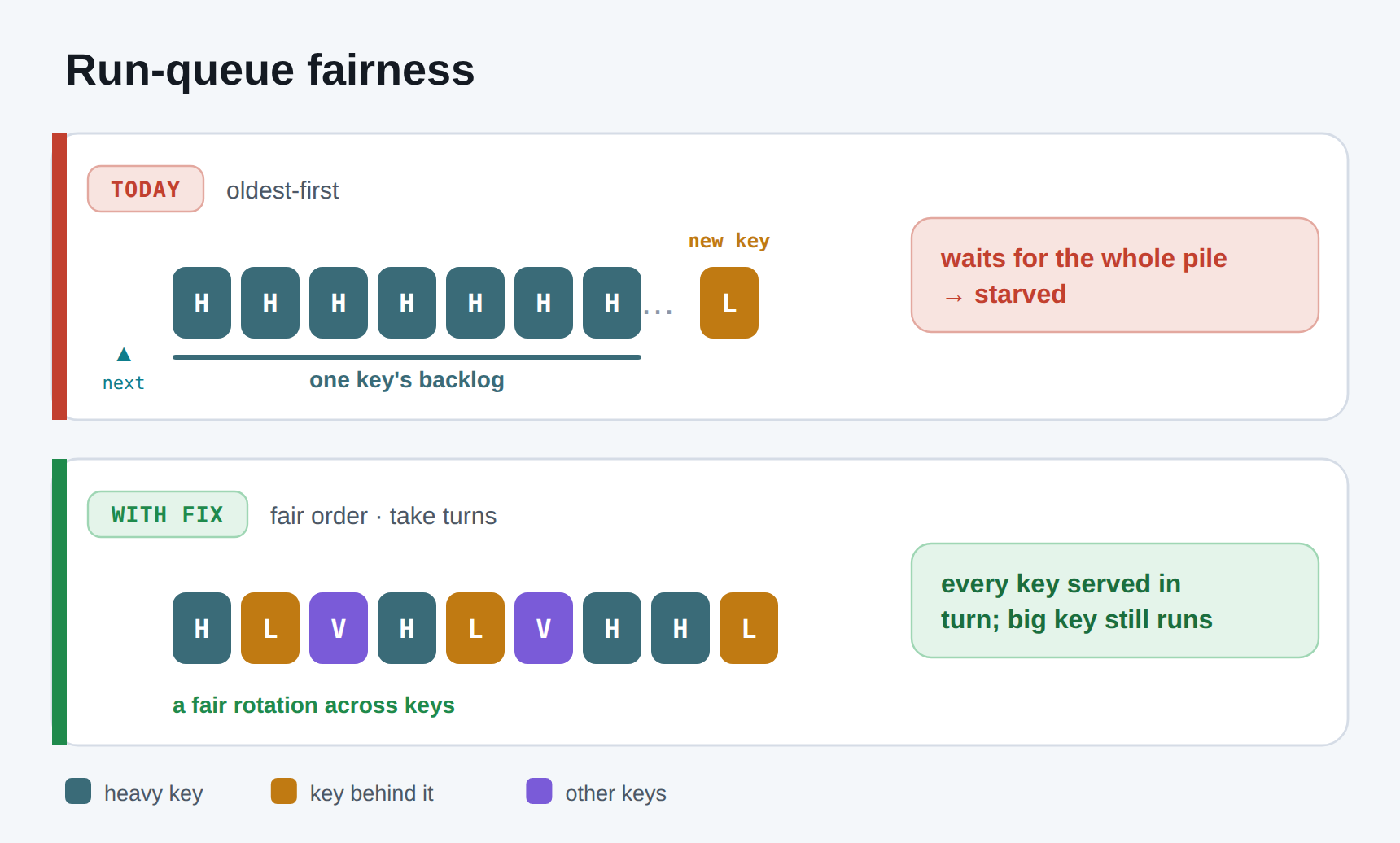 ## How it works 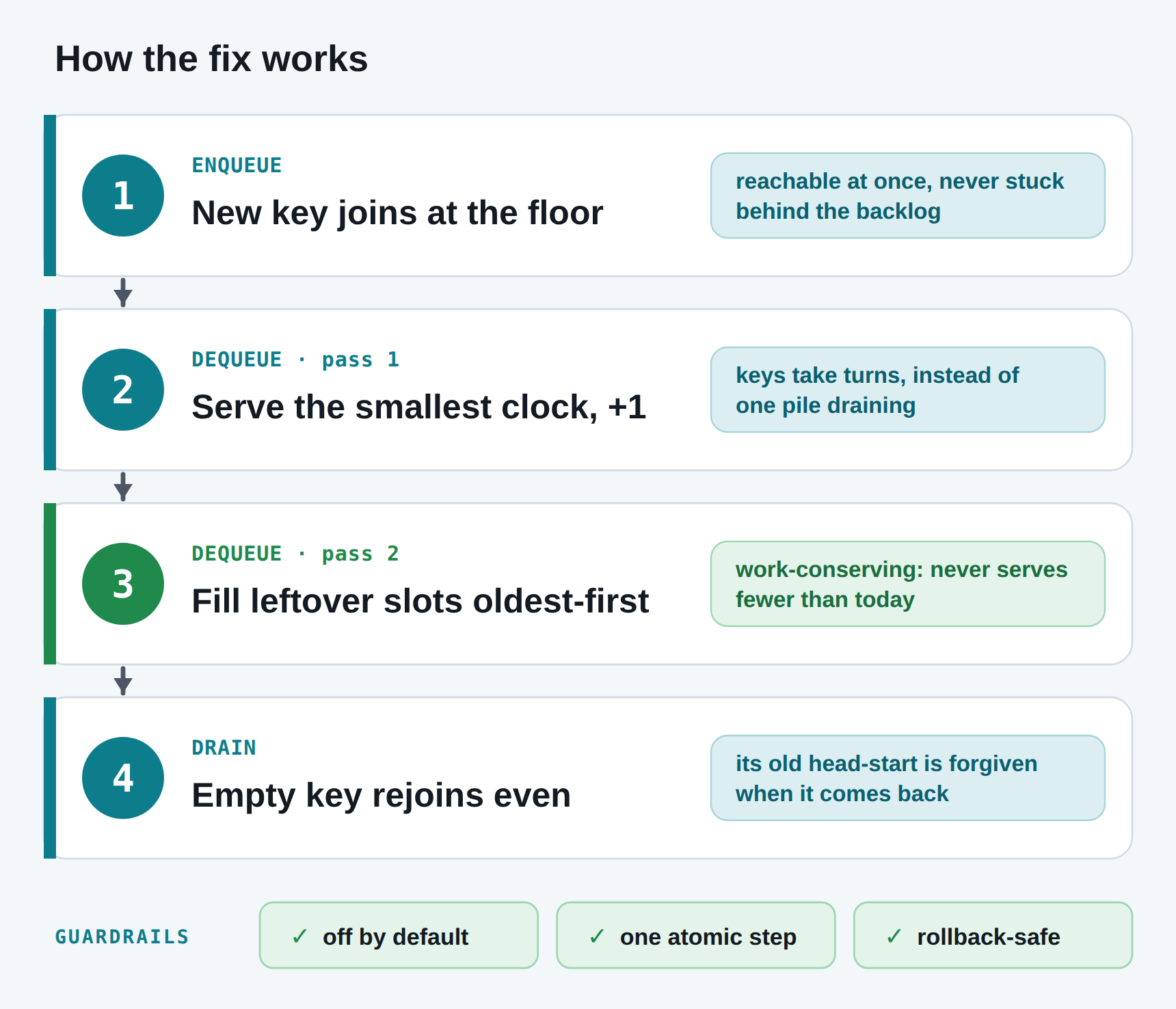 - Three keys per base queue: `:ckVtime` holds a virtual-time tag per variant, `:ckVtimeFloor` is the current virtual time, and `:ckVtimeIdle` remembers the tags of variants that have drained. `ckIndex` keeps its head-timestamp domain, so time-eligibility, master-queue rebalancing and every other writer stay untouched, which is what makes it mixed-deploy safe. - A flag-selected two-pass dequeue. Pass 1 serves the lowest tags and charges each serve a quantum, bounded by a window of `maxCount * RUN_ENGINE_CK_VTIME_WINDOW_MULTIPLIER`. Pass 2 fills any leftover slots in today's age order and discovers variants that have no tag yet, so the command is a strict superset of today and stays work-conserving. - Only pass-1 serves move the floor, so a variant that cannot be served cannot drag the clock along behind it. - A draining variant parks its tag in the idle set and takes it back on its next enqueue or nack, so draining and returning isn't a way to reset your clock. All four routes out park it: the dequeue, ack, dead-letter and TTL expiry. - A brand-new variant joins one quantum behind the current leader rather than at the floor. Registering at the floor is what let a tenant sharding across fresh keys outrank everything already waiting, and it's now reserved for repair (pass-2 discovery and the gated batch), where everything in sight is established work that lost its tag. - A candidate that can't be served this call, because its head is scheduled in the future or it's at its per-key concurrency ceiling, says so instead of spending one of pass 1's window slots. - New behaviour lives only in new Lua command names. The existing enqueue/dequeue/nack scripts are byte-for-byte unchanged, which is checkable by hashing each script body, so flag-off is identical to today. ## Numbers Fairness, flag OFF against ON under the same load on the same box, wait measured in logical dequeue steps: | scenario | victim wait p99 | Jain fairness | | --- | --- | --- | | skewed backlog | 636 -> 196 (-69%) | 0.34 -> 1 | | trickle behind a backlog | 596 -> 176 (-70%) | 0.50 -> 1 | A fresh key minted per run against a 2000-deep backlog: the backlogged variant went from 1 slot in 600 to 120 in 600, which is what age order would have given it. Cost, measured saturated with the generator next to Redis, 1M invocations an arm: | path | flag-on cost | scaling | | --- | --- | --- | | enqueue | +1.8 usec | flat, 100 to 50k keys | | dequeue, serving | +3 to 4% call p95 | from the fairness runs above | | dequeue, every variant gated | 33.5 usec at 1k keys | 36.4 at 10k | | memory at rest | none | the idle set doesn't exist until something drains | | memory under churn | ~1.5MB per queue | capped by rank at 10k entries | Rule of thumb that fell out of the sweep, useful for costing anything else added to these scripts: about 1.38 usec fixed per EVALSHA plus 0.33 per `redis.call`. ## Testing 176 tests across the run-queue suite, green with the flag off and on. Fairness is proven on the real batched dequeue path rather than one message per call, plus multi-consumer exactly-once, a per-dequeue op-count budget, and behaviour tests for the floor, tag advance, GC, registration and the credit round trip through every drain path. Two mutation audits (33 mutations, one change to the production Lua at a time, rerun the suites, on the principle that a green run against a broken invariant is a hole). They found six things nothing was checking, all now covered: the pass-1 guard for a future-scheduled head, the idle park on ack, dead-letter and TTL expiry, nack's credit restore, the dead-letter caller, the TTL enqueue's own copy of the registration block, and any quantum other than 1. ## Rollout Off by default behind `RUN_ENGINE_CK_VTIME_SCHEDULING_ENABLED`, with `RUN_ENGINE_CK_VTIME_QUANTUM`, `RUN_ENGINE_CK_VTIME_WINDOW_MULTIPLIER` and `RUN_ENGINE_CK_VTIME_STATE_TTL_SECONDS` for the knobs. Enable on a staging cell, then production. Rollback is flipping the flag off, and leftover state expires within a day. During a rolling deploy, old instances serve in age order and are folded in by pass 2, so nothing is lost and no run is served twice. Every mutation is a single atomic Lua script, which is what makes those interleavings safe. That atomicity assumes the single-node Redis the run queue actually runs on: it has no cluster-mode setting (every other Redis in `env.server.ts` has one, `RUN_ENGINE_RUN_QUEUE_REDIS_*` doesn't), and the master queue key sits outside the base queue's hash slot exactly as it does in the command this one is modelled on. ## Known limitations **Registration order sets relative priority.** Within the fair pass a variant's tag comes from when it joined and how much it has been served, so message age doesn't break in. A key that arrives during a busy period sits a quantum behind the leader and keeps that place until the floor catches up. This is deliberate, since the alternative (strict fair share) makes minting fresh keys pay, and it's worth confirming against a real high-cardinality workload before the flag goes on anywhere. **Ties break lexically.** Variants on the same tag, at a cold start or when a collected variant re-registers, are served in queue-name order. It's a pre-existing effect of the old head-timestamp ordering and only affects who goes first, not long-run fairness. **The vtime scripts are copies.** Seven pairs, about 688 identical Lua lines, kept as copies so the flag-off path stays byte-identical. A change to one of the originals doesn't reach its copy, which already happened once on this branch (main added a TTL re-registration to `dequeueMessagesFromCkQueueTracked` and the copy went without it until 7f01aaf). A follow-up PR will pin each copy against its original so drift shows up as a red check.


Stream closure alone cannot confirm that a specific action's input was
processed; this adds an optional per-call `onSettled` callback to
`TriggerChatTransport.sendAction()`.

## ✅ Checklist

- [x] I have followed every step in the [contributing
guide](https://github.com/triggerdotdev/trigger.dev/blob/main/CONTRIBUTING.md)
- [x] The PR title follows the convention
- [x] I ran and tested the code works

---

## Testing

SDK build, 770 SDK tests (including 45 real-HTTP settlement tests),
ESM/CommonJS package smoke checks, formatting, lint, and Knip passed;
live-worker E2E was not run.

---

## Changelog

Adds validated, once-per-call settlement with cancellation and
supersession safeguards, public types, API documentation, and a patch
changeset.
Documents that settlement does not prove application success and that a
missing callback does not make retrying safe.

---

## Screenshots

Not applicable — no visual changes

💯
Improve the first GitHub deployment experience: Deploy now explains when a branch doesn't exist on GitHub, a harmless first-build cache message no longer shows as an error, the deployment panel stays on screen after the first deploy finishes, the empty development Tasks page uses the new setup layout, and the deployment setup screen is vertically centered.

Mono-RevId: 07d4623e6fbe912906e1976f513f962c5ec42aa6
This branch has not been deployed
This file contains hidden or bidirectional Unicode text that may be interpreted or compiled differently than what appears below. To review, open the file in an editor that reveals hidden Unicode characters.
Learn more about bidirectional Unicode characters
Sign up for free
to join this conversation on GitHub.
Already have an account?
Sign in to comment
17 participants


Add this suggestion to a batch that can be applied as a single commit.This suggestion is invalid because no changes were made to the code.Suggestions cannot be applied while the pull request is closed.Suggestions cannot be applied while viewing a subset of changes.Only one suggestion per line can be applied in a batch.Add this suggestion to a batch that can be applied as a single commit.Applying suggestions on deleted lines is not supported.You must change the existing code in this line in order to create a valid suggestion.Outdated suggestions cannot be applied.This suggestion has been applied or marked resolved.Suggestions cannot be applied from pending reviews.Suggestions cannot be applied on multi-line comments.Suggestions cannot be applied while the pull request is queued to merge.Suggestion cannot be applied right now. Please check back later.
Closes #
✅ Checklist
Testing
[Describe the steps you took to test this change]
Changelog
[Short description of what has changed]
Screenshots
[Screenshots]
💯